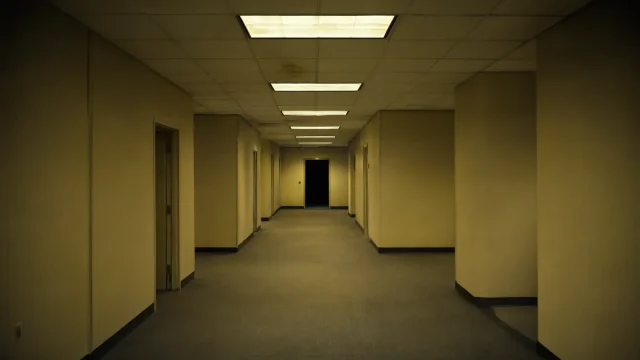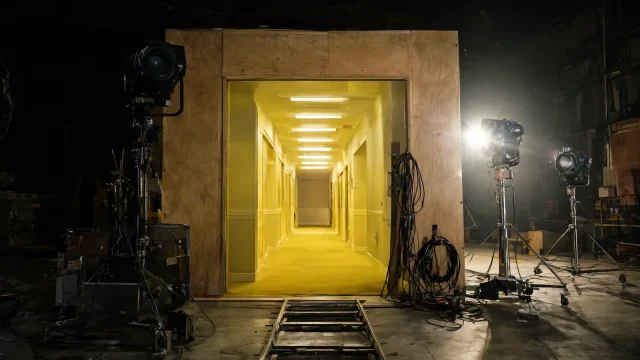
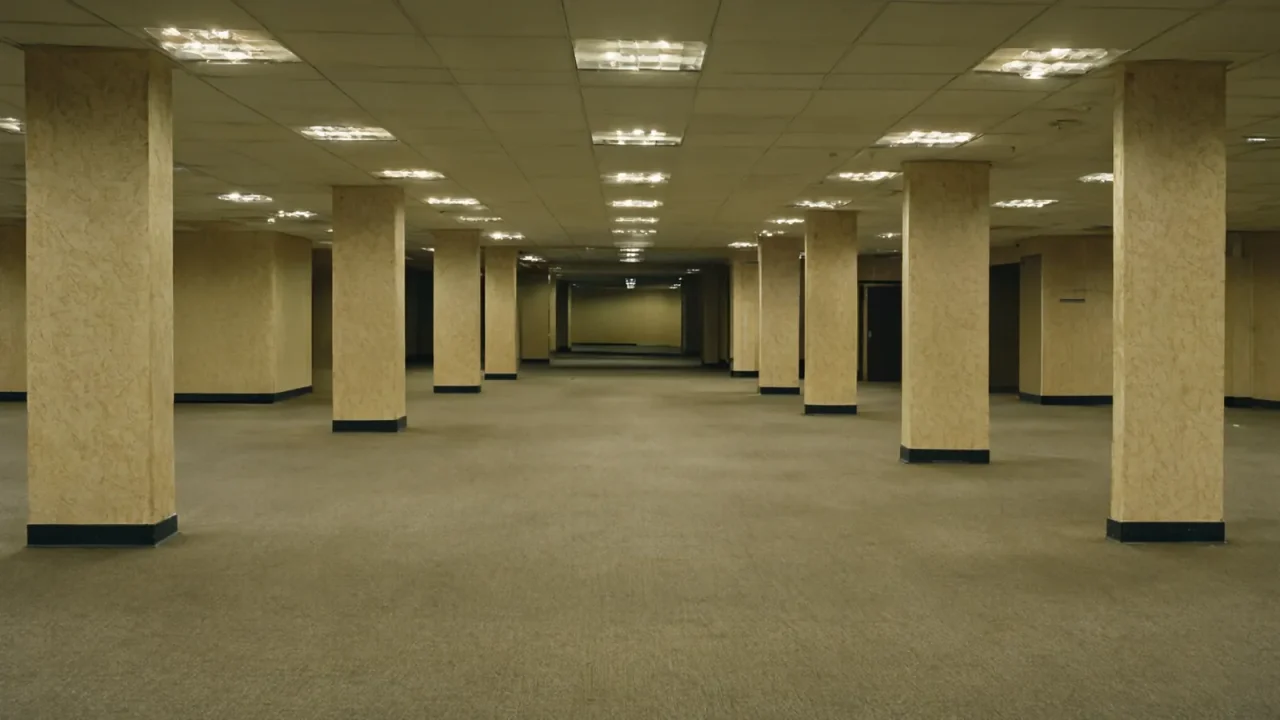
Inside the broader Backrooms encyclopedia hub, Backrooms Level 0 marks the entry threshold where most displaced travelers awaken after slipping past baseline reality. To prevent mixing incompatible wiki lore, the main sections below strictly follow the current Backrooms Wikidot canon—designated Level 0: “Threshold” and nicknamed “The Yellow Hell”—before isolating Fandom, Kane Pixels, and playable adaptations in dedicated sections.
Under Wikidot documentation, this opening floor acts as an unforgiving attrition trap. Unprepared wanderers stumble across seemingly infinite office-style partitions, hallways, and staircases where dehydration, starvation, acoustic fatigue, and disorientation claim lives long before survivors ever reach inhabited zones.
Field Classification and Overview of Backrooms Level 0
The Wikidot entry descends from the May 12, 2019 thread on 4chan’s paranormal board /x/—where an anonymous poster invited “disquieting images” and a responder coined the setting—initially adapted on Reddit by u/Deveyerr before Wikidot contributors DrAkimoto and DivineAtlas rewrote the dossier under CC BY-SA 3.0, paired with a Creative Commons render contributed by Alfarex on the TS Discord. Its Survival Difficulty rating signals a stable baseline environment with unconfirmed fauna, yet environmental deprivation keeps mortality steep.
| Field Parameter | Wikidot Specification |
|---|---|
| Designation | Level 0 — “Threshold” (nicknamed “The Yellow Hell”) |
| Survival Difficulty | Class 1: Safe / Secure / Unconfirmed Entities |
| Spatial Topology | Sprawling retail-office maze; mutates via Peripheral Shift |
| Social conditions | Total solitary isolation (one near-impossible room exception) |
| Primary hazards | Dehydration, starvation, delirium, acoustic surges, tainted carpet fluids, aberrations |
| Confirmed Exit | Pass through a flickering wall to transition into Level 1 |
Structurally, Backrooms Level 0 resembles deserted service corridors behind outdated offices or retail showrooms, defined by disorienting yellowed wallpaper and mildew-scented floors. Windowless rooms join haphazard corridors and isolated stair flights with zero natural light; no two sectors repeat an identical geometry, stripping away time perception and accelerating malignant delirium.
Carpets, Lighting, and Acoustic Hazards per Wikidot
Physical materials across Level 0 carry real biological hazards. Nearly every floor surface is covered by one continuous, seamless sheet of tight-knit Berber carpeting made of an unknown abrasive synthetic fiber. Although harsh overhead glare casts a sickly yellow hue in photographs, isolated samples appear brownish beige.
Chemical sampling logged by Wikidot indicates that the moisture saturating this flooring has unknown origins and contains hazardous mixtures—salt water, brackish water, contaminated Almond Water, Liquid Pain, formalin, and slurries containing human and non-human DNA. Base Alpha medical teams warn survivors never to wring moisture from the carpet or swallow fibers out of desperation, noting fatal blockages and carpet-borne illnesses among delirious arrivals.
Abundant ambient noise saturates Level 0 continuously. Overhead fluorescent bulbs emit nonstop buzzing whose volume spikes unpredictably to levels capable of causing hearing damage, and extended exposure routinely triggers throbbing migraines that linger even after leaving the floor. During volume surges, standard survival protocol advises covering your ears and walking rapidly away. Explorers also log phantom auditory anomalies—indistinct whispers, familiar voices calling out, and nail-like scratching behind partition drywall—with zero verified physical source. Ignore every sound and stay moving.
Peripheral Shift and the Isolation Effect
Two systemic rules dismantle teamwork and conventional mapping inside Wikidot Level 0. First, the Peripheral Shift causes unobserved passages to warp, elongate, or rearrange entirely. A traveler who marks corners and counts ceiling lights across two days of walking can pause to rest, glance backward, and discover an altered corridor erasing every charted step.
Second, the Isolation Effect enforces absolute solitude. Even two travelers falling out of reality side by side never encounter one another inside Level 0; shouting, leaving written notes, or scratching walls produces zero contact. Wikidot records acknowledge a single improbable small chamber where travelers can see one another, yet shifting architecture renders locating it virtually impossible.
That same isolation leaves entity status unresolved. Wikidot confirms no verified encounters with creatures inside Level 0—noting any inhabitants would likely experience isolation too—though wanderers regularly describe dark figures hovering along distant corners alongside acute scopophobia, intense visual or auditory hallucinations, and rare spirals into utter lunacy.
Catalog of Structural Aberrations on Level 0
Despite the level’s oppressive visual sameness, extended traversal exposes wanderers to five recurring architectural anomalies. Spotting warning cues early separates survivors who conserve stamina from those lost inside sealed traps.
| Aberration | Physical & Visual Cues | Hazard Level | Recommended Action |
|---|---|---|---|
| Arches | Pale walls pierced by arch cutouts; deeper soaked carpet | Low–Moderate (wading fatigue) | Use stable geometry to reorient; rest briefly on wide ledges |
| Pillars | Mile-wide grid halls of columns; shallower, drier floor | Moderate (shifting paths behind you) | Commit to one straight heading; sleep facing forward |
| Holes | Clustered pitch-black floor pits; light penetrates only feet | High (no known fall survivors) | Skirt around; avoid entirely when fatigued or dehydrated |
| Blackout Zones | No overhead light or buzz; rough walls; ankle-deep floor fluid | High (rapid shifting in darkness) | Sprint toward the first glimmer of light or returning hum |
| Red Rooms | Reddish hue, peeling paper showing crimson, sticky coarse carpet | Extreme (closed, inescapable loops) | Reverse course immediately upon noticing red cues or paranoia |
Arches and Pillars
Archway rooms typically appear at dead ends or transition sections. Deep liquid-trapped carpet drains energy, yet Wikidot ranks archway sectors as the level’s most spatially stable pockets—resisting behind-the-back layout shifts and occasionally offering narrow ledges off the wet floor. Pillar halls stretch for miles in repeating column lattices over shallower, drier carpet tempting tired explorers to sleep. Because pillars behind a traveler rearrange readily, survivors recommend locking onto one heading; one logged wanderer needed 14 days and carried Almond Water to exit a massive column room.
Holes, Blackout Zones, and Red Rooms
Hole grids puncture the flooring with dark shafts swallowing flashlight beams within a few feet; despite rumors of voices or blue glow below, no fallen explorer has reported surviving. Blackout Zones plunge whole sectors into abrupt silence, rough walls, recessed ankle-deep liquid, and aggressive shifting—requiring an immediate dash toward faint light or buzzing fixtures, even as echoes jump unpredictably. Most dangerous of all are Red Rooms, disconnected closed loops that provoke acute claustrophobia and paranoia even nearby. Peeling crimson underlayers and thick, sticky carpeting signal an urgent rule: turn back before crossing inside.
Documented Entrances, Exits, and Field Survival Protocol
Wikidot keeps entry and escape routes sparse compared to multi-exit fan forks:
- Entrances: Slipping through the creases of baseline reality (noclipping) remains the primary arrival route for most newcomers, supplemented by scattered hidden entries from other levels.
- Exits: Survive solitary attrition, steer clear of floor pits and Red Rooms, and keep moving until spotting a visibly flickering wall—then hurl yourself straight through it to emerge in Level 1 alongside surviving human outposts.
In real-world provenance, the iconic blueprint for Backrooms Level 0 traces back to archival renovation photographs—chiefly Dsc00161.jpg (the slanted Dutch-angle yellow interior) and DSC00159.jpg (archway partitions). Shot on June 12, 2002, with a Sony Cyber-shot during second-floor renovations at 807 and 811 Oregon Street in Oshkosh, Wisconsin—occupied for decades by Rohner’s Home Furnishings before HobbyTown took over 807 Oregon Street in 2003—the photos were uploaded to the branch’s renovation blog on March 2, 2003, captioning the space as “the East (Oval) room” with water damage requiring clearance. A Discord community dedicated to the Backrooms finally located that archived page via the Wayback Machine in May 2024; the photographed layout itself vanished long ago when the floor became an indoor track for racing radio-controlled cars.
Beyond the Flickering Wall: Level 1, Level 2, and Almond Water Logistics (per Wikidot)
Surviving Level 0 matters only if a wanderer understands what waits immediately beyond its flickering-wall exit. Per Wikidot’s connected level dossiers, crossing that threshold deposits exhausted travelers directly into Level 1, commonly nicknamed The Habitable Zone—a dramatic structural contrast against Level 0’s solitary attrition.
Level 1: The Habitable Zone per Wikidot
Per Wikidot, Level 1 unfolds as a vast warehouse and concrete parking complex divided into recognizable districts that make orientation far more reliable than Level 0’s warping partitions. Its best-known region, the Aquila Sector, pairs grey concrete floors and walls with colossal structural pillars. Adjacent supply halls hold crates that unpredictably vanish when left unwatched, while overhead industrial pipes drip unsafe condensation across damp slabs. Crucially, the Isolation Effect disappears upon arrival: wanderers can finally meet other survivors, trade goods, and locate active Major Explorer Group (M.E.G.) hubs such as Team Hippocrates and Team Compass Point.
Level 2: Pipe Dreams and Early Settlement History per Wikidot
Deeper exploration from Level 1 leads into Level 2 (Pipe Dreams), an unending network of tight Euclidean maintenance corridors lined with noisy industrial pipes. Per Wikidot records, aside from ancient nomadic wanderers known as The Lost who traversed these tunnels centuries earlier, early cataloged inhabitants included The Macchina. Between 1995 and 2013, a small altruistic collective of roughly 35 volunteers called the Aiding Stragglers ran temporary housing and survival classes along Level 2 for newcomers displaced directly from The Frontrooms, pairing sheltered arrivals with trained scavengers to gather rations safely from neighboring corridors. Later infrastructure expansion by the Backrooms Nonaligned Trade Group (B.N.T.G.) around Office Space EL3A triggered a sweeping blackout that left the tunnels darker and colder, increasing danger from roaming Smilers and other hostile fauna.
Object 1: Almond Water as Survival Ration and Currency per Wikidot
Across every habitable corridor beyond Level 0, logistics revolve around Object 1 (Almond Water). Per Wikidot’s object dossier, a single standard thermos bottle supplies roughly 600 calories of balanced nutritional value—meaning three bottles per day sustain an average healthy explorer without solid food. Because reliable sustenance is scarce across unstable tiers, seasoned travelers carry surplus bottles into heavily settled districts like Level 11 and Level 6.1, where Almond Water serves as the standard medium of trade. Field logs also note distinct chemical variants: while sealed bottles keep travelers hydrated and ward off exhaustion, grey-tinted Almond Water can temporarily pacify certain hostile entities including Deathmoths and Jerry—though unsealed containers found on damp Level 0 floors remain strictly unsafe due to contamination and tampering.
Beyond M.E.G. and B.N.T.G., Wikidot’s Groups of Interest archive documents eccentric commercial and technological outfits operating inside populated zones—including service providers such as Backrooms Remodeling and Furniture Co. and engineering firms like Backrooms Robotics, whose devices span practical gear like Lamps and Mobile Vacuum Cleaners up to complex artificial intelligence systems such as Koko.
Real-World Geography: Oshkosh, Wisconsin and Liminal Psychology
Understanding why a single 2002 renovation snapshot captured global imagination requires looking at both its ordinary Midwestern provenance and the perceptual theory behind empty interiors. Situated beside Wisconsin’s Fox River where Lake Butte des Morts meets Lake Winnebago, Oshkosh operates as Winnebago County’s administrative seat. The settlement took its name from Menominee Chief Oshkosh—whose name translates as “claw,” cognate with Ojibwe oshkanzh—and drew early European fur traders as early as 1818 before the 1820s southwest Wisconsin mining boom, the Erie Canal, and publicity surrounding the 1832 Black Hawk War reshaped regional migration across Wisconsin.
Nearly two centuries later, a mundane commercial remodel at 807 Oregon Street inside that quiet Fox River city produced Dsc00161.jpg—a slanted Sony Cyber-shot photograph capturing bare drywall dividers, damp flooring, and fluorescent lighting before workers built an indoor radio-controlled car track. Stripped of store signs, tools, and people, that utilitarian back room became an ideal vessel for what Pulse: The Journal of Science and Culture critic Peter Heft—building on theorist Mark Fisher—termed a “failure of presence.” Viewers instinctively expect clerks, shoppers, or office staff inside partitioned commercial corridors; encountering unbroken vacancy activates architectural unease even before any fictional monsters enter the picture.
Comparing Wikidot, Fandom, and Kane Pixels Canons
Online guides often blur conflicting continuities—mentioning an orange resting chamber, climbable vents, or pursuing wire-like creatures. The table below isolates how rival canons diverge from our primary Wikidot dossier.
| Comparison Axis | Wikidot (Primary Here) | Backrooms Fandom Wiki | Kane Pixels (YouTube & 2026 Film) |
|---|---|---|---|
| Hazard Rating | Survival Difficulty Class 1 (Safe / Secure / Unconfirmed Entities) | Class 1 Threat Index: Safe, Unstable, completely without entities | No numbered levels or survival classes |
| Entities | Unconfirmed; likely separated by Isolation Effect | Explicitly devoid of all life; sightings deemed hallucinations | Hostile creatures actively hunt trespassers in yellow corridors |
| Unique Features | Five aberrations (Arches to Red Rooms) + Peripheral Shift | The Manila Room (orange glow), 1-meter dusty ceiling crawlspace, Limina Theory | Async portals opened in the 1980s and temporal anomalies |
| Exit routes | Throw yourself through a flickering wall into Level 1 | Manila Room (Level 1/2), Exit doors (0.01, 14, !), vents (0.1/0.66), walking to Level 1 garages, glass doors (Level 13), random noclip | Async thresholds or unstable reality rifts |
The Fandom Wiki (built by Wisp, Egglord, and log author Portul) removes living fauna entirely while highlighting an indecipherable signature on the reverse of a tattered Level 0 photograph and faint carpet indents hinting at vanished furniture. Its Limina Theory frames the Backrooms as an extranormal dumping ground tied to water accidents and historical disappearances—citing the 1935 Yangtze floods, Amelia Earhart, the MV Joyita, and older losses such as the Santa Maria and Royal Merchant. Fandom also introduces The Manila Room—whose duller, orange-tinted overhead fixture and manila-patterned walls offer a calming rest stop opening to Level 1 or Level 2—alongside an unbreathable one-meter dusty gap above the drop ceiling and the June 13, 2022 expedition log “Staring Back,” noting vertical-lined wallpaper and crumbling outlets.
Meanwhile, collaborative fandom split early across Reddit: by March 2022, r/backrooms had grown past 157,000 members, whereas user LitheBeep founded r/TrueBackrooms to preserve strictly the 2019 4chan text describing roughly 600,000,000 square miles of empty rooms. ABC News observed that this decentralized structure complicated separating serious worldbuilding from jokes, even as collaborative wikis grew along lines resembling the SCP Foundation model.
Kane Pixels Continuity: Async Research Institute and The Lifeform
Readers moving from Wikidot dossiers to Kane Parsons’s YouTube series and the 2026 A24 feature film (directed and co-scored by Parsons—born June 18, 2005 in Petaluma, California and educated in California at Novato High School’s Marin School of the Arts—from Will Soodik’s script starring Chiwetel Ejiofor as Clark and Renate Reinsve as therapist Mary) encounter an entirely separate science-fiction premise. Rather than random noclipping into numbered survival tiers, Parsons anchors the yellow corridors around the Async Research Institute (also called the Async Foundation), a private San José, California laboratory founded in 1983 by physicist Lawrence Altman. After initially designing MRI hardware and receiving a $1.2 million federal grant on June 3, 1987 for next-generation imaging equipment, Async pivoted around April 1988 toward Project KV31—deploying a Low-Proximity Magnetic Distortion System to open a doorway into the Complex in hopes of solving residential crowding and commercial storage costs.
That continuity also breaks sharply from Wikidot’s entity-free Level 0 by populating its yellow corridors with The Lifeform—a hostile bacterial species encountered by lost civilians and Async surveyor Marvin E. Leigh. Standing roughly 11 feet (3.35 meters) tall when upright, the creature displays long vine-like limbs resembling tangled black wires beneath heavy VHS distortion and is implied to consist of mutated hay bacillus colonies. Though rarely captured delivering a lethal blow directly onscreen, canon records attribute multiple disappearances—including the cameraman of the original found-footage upload and subsequent unnamed victims—to these roaming predators, illustrating why Level 0 lore must always identify which continuity a guide follows.
Playable Level 0 Games, Film Adaptations, and Pop Culture
Because the yellow-carpeted opening maze conveys dread without complex exposition, Backrooms Level 0 became the signature playable stage across indie horror games and screen adaptations:
- Indie video games: Only two months after the May 2019 4chan post, Pie on a Plate Productions launched an atmospheric short indie game that earned praise for mood despite its brevity. Later playable projects expanded Level 0 into survival and co-op loops, including Enter the Backrooms, Noclipped, The Backrooms Project, Steelkrill Studio’s The Backrooms 1998 (2022), and Fancy Games’s co-op hit Escape the Backrooms (2022), which Bloody Disgusting commended for integrating extended wiki lore.
- Kane Parsons’s YouTube series and 2026 A24 feature: In January 2022, then-16-year-old Northern California filmmaker Kane Parsons (Kane Pixels) uploaded The Backrooms (Found Footage), built over a month in Blender and Adobe After Effects; by August 2026 that debut surpassed 90 million views, anchoring a 25-episode web series totaling over 197 million views and earning a 2022 Streamy Awards Creator Honors nod from The Game Theorists. Critics from WPST, Otaku USA, Kotaku, Dread Central, and Nerdist praised its restraint (comparing it to the 2019 game Control), while Boing Boing writer Rob Beschizza jokingly wondered whether Hollywood would repeat the panned 2018 Slender Man film. On February 6, 2023, A24 announced a feature directed by Parsons—scripted initially by Roberto Patino and later Will Soodik, with James Wan and Michael Clear producing for Atomic Monster alongside 21 Laps partners Shawn Levy, Dan Cohen, and Dan Levine—which debuted in U.S. theaters May 29, 2026 (see our Backrooms movie release guide), briefly incorporating Parsons’s take on the Poolrooms alongside Grytt Picture Shows’s separate December 2026 feature The Poolrooms.
- Television, music, and internet culture: Creator Dan Erickson cited the Backrooms among influences on Severance (2022). In October 2024, the third season of American Horror Stories aired a Huluween episode titled Backrooms starring Michael Imperioli. That same year, rapper Juice Wrld’s posthumous album The Party Never Ends paired “Party By Myself” with Backrooms-inspired visuals, following a 2022 Google Earth TikTok trend and preceding 2026 references in xkcd and the South Park episode “You Like That on Your Face.”
Further field guidance per Wikidot underscores how sharply survival priorities change across the transition from Level 0 into Levels 1 and 2. Inside Level 0, an explorer carries virtually zero capacity to barter or restock; every hour spent wandering without locating a flickering partition raises the threat of dehydration and auditory fatigue. Once inside Level 1’s Habitable Zone, however, concrete warehouse lanes supply recurring crates whose contents range from tools and batteries to sealed supplies, allowing M.E.G. logistics squads to stabilize incoming survivors before routing them onward. Experienced field teams warn that careless travelers who linger too long along unlit Level 1 corridors or descend prematurely into Level 2 without sealed Almond Water face sharply elevated risks from Smilers, Hounds, and Skin-Stealers patrolling darker industrial bays.
This structural progression also clarifies why Level 0 serves as the architectural anchor for the entire Wikidot taxonomy. By stripping away daylight, exterior windows, reliable clocks, and human companionship right at entry, Threshold establishes the psychological baseline that makes subsequent concrete warehouses, humming pipe tunnels, and populated trading hubs feel earned rather than arbitrary. Whether readers approach the setting through collaborative Wikidot survival files, Fandom’s multi-exit lore, or Kane Parsons’s San José corporate-experiment continuity centered on Async’s 1988 KV31 gateway, the yellow-lit opening floor remains the unmistakable signature of modern liminal horror.
Frequently Asked Questions
What is the survival difficulty of Backrooms Level 0?
In primary Wikidot canon, Level 0 is rated Survival Difficulty Class 1: Safe, Secure, and Unconfirmed Entities. Despite that rating, dehydration, starvation, delirium, floor pits, and Red Rooms make survival arduous for unprepared wanderers.
Are there entities inside Level 0?
Wikidot lists entities as unconfirmed, noting any creatures present would likely also be separated by the Isolation Effect; shadowy sightings may stem from exhaustion or scopophobia. Fandom explicitly declares the level devoid of life, while Kane Pixels places pursuing monsters inside the yellow halls.
How do you exit Level 0 in Wikidot canon?
Current Wikidot documentation lists one primary exit: endure the shifting corridors until locating a flickering wall and throw yourself through it to enter Level 1. Marked exit doors, crawl vents, and the Manila Room belong to Fandom continuity.
Is the Manila Room part of Wikidot Level 0?
No. The Manila Room—an orange-lit resting chamber with manila-patterned walls leading to Level 1 or Level 2—belongs to the Backrooms Fandom Wiki canon rather than the current Wikidot rewrite.
Where was the real photo behind Backrooms Level 0 taken?
Discord researchers traced the original Dsc00161.jpg photograph in May 2024 to a March 2, 2003 renovation blog for HobbyTown at 807 Oregon Street in Oshkosh, Wisconsin (formerly Rohner’s Home Furnishings), photographed on June 12, 2002 before being turned into an RC race track.
Sources and Licensing
- Level 0 — “Threshold” (Backrooms Wikidot) by Wikidot contributors (CC BY-SA 3.0) — primary Wikidot source for classification, carpet samples, aberrations, and exit mechanics.
- The Backrooms — English Wikipedia (Revision 1387336964, CC BY-SA 4.0) — 2019 4chan origin, 2002 Oshkosh photograph verification, Kane Pixels overview, and game adaptations.
- Level 0 — Backrooms Fandom Wiki (Revision 1397338, CC BY-SA 3.0) — consulted strictly for the canon comparison chapter (The Manila Room, Limina Theory, and Fandom exits).
- Level 1 – “Habitable Zone” — Backrooms Wikidot (CC BY-SA 3.0, rev. 83).
- Level 2 – “Abandoned Utility Halls” — Backrooms Wikidot (CC BY-SA 3.0, rev. 93).
- Object 1 – “Almond Water” — Backrooms Wikidot (CC BY-SA 3.0, rev. 44).
- Groups — Backrooms Wikidot (CC BY-SA 3.0, rev. 272).
- Backrooms (film) — Wikipedia (CC BY-SA 4.0, rev. 1387832072).
- Kane Parsons — Wikipedia (CC BY-SA 4.0, rev. 1387996904).
- Liminal space — Wikipedia (CC BY-SA 4.0, rev. 1386321934).
- Async Research Institute — Kane Pixels Backrooms Wiki (CC BY-SA 3.0, rev. 25480).
- The Lifeform — Kane Pixels Backrooms Wiki (CC BY-SA 3.0, rev. 26185).
- Oshkosh, Wisconsin — Wikipedia (CC BY-SA 4.0, rev. 1382982302).