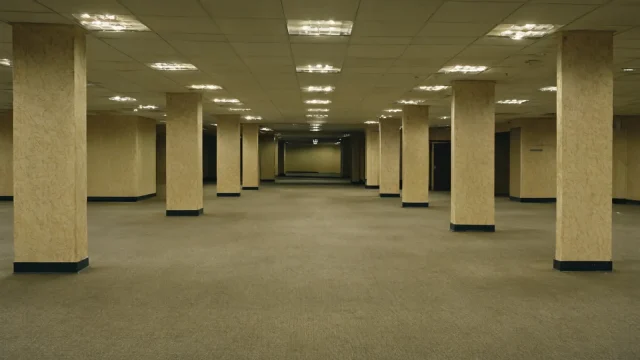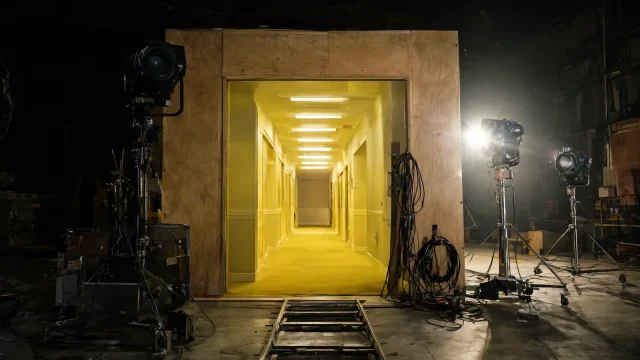
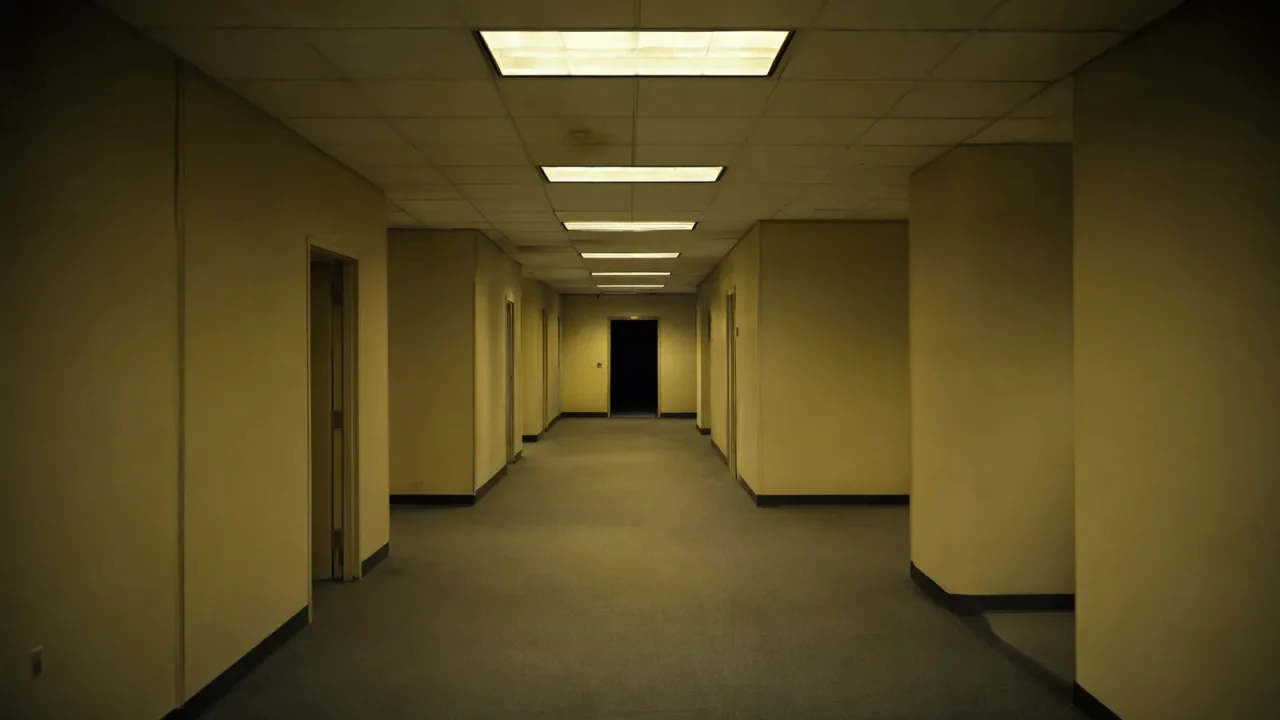
Starting from an anonymous imageboard reply posted in May 2019, the Backrooms grew into a sprawling collaborative horror mythos spanning survival wikis, indie games, a 25-episode YouTube anthology, and a hit 2026 feature film. That terse opening warning imagined falling past the seams of everyday reality into damp yellow office partitions lit by buzzing overhead fluorescent tubes.
This field handbook separates documented real-world history from wiki lore. All core descriptions of levels, entities, objects, and human groups below draw directly from individual Backrooms Wikidot dossiers (explicitly noted as per Wikidot), while Fandom, Wikipedia, and Kane Parsons canon differences are isolated in a dedicated comparison section.
Core Premise and What the Backrooms Represent
In collaborative internet folklore, the Backrooms forms a pocket dimension hidden beneath consensus reality. Travelers enter through noclipping—a video game debugging term describing movement straight through solid floors or walls. Rather than landing inside a gothic castle or alien desert, a displaced wanderer awakens amid windowless commercial partitions stripped of furniture, signage, and human presence.
Three sensory hallmarks anchored the original 2019 post: stale damp carpeting, mono-yellow walls, and ceiling fluorescent lamps buzzing at maximum hum. Unlike slasher creepypastas centered on shock gore, early stories drew dread from solitude, architectural monotony, and unseen danger. Cultural critics link the premise directly to liminal horror because it converts familiar retail back offices and waiting hallways into an unforgiving survival zone.
Because no single copyright owner governs the concept, it operates as an open shared universe comparable to the SCP Foundation. Minimalist branches preserve a solitary yellow trap without factions or level numbers, while Wikidot and Fandom catalog numbered floors, survival classes, Almond Water rations, and organized survivor coalitions.
Documented Origins From 4chan to Oshkosh, Wisconsin
Public history opened on May 12, 2019, on 4chan’s paranormal board /x/, when an anonymous poster requested unsettling pictures that felt subtly “off” and attached a tilted photograph of empty partitioned rooms washed in yellow light. Archival notes on the Russian edition of Wikipedia record that the same photograph had circulated earlier on April 22, 2018, inside a cursed-images thread before inspiring the 2019 mythos.
Another anonymous commenter named the place the Backrooms, estimated approximately 600 million square miles (roughly 1.5 billion square kilometers) of randomly segmented empty rooms, and warned that hearing footsteps nearby meant something had already heard the traveler. On May 15, 2019, a third user merged the photograph with a screenshot of that reply into a viral image, fueling stories, memes, and corridor generators across Reddit, Twitter, YouTube, and TikTok.
The photograph’s real-world origin remained anonymous until May 2024, when researchers on a dedicated Discord server used the Wayback Machine to uncover a March 2, 2003 renovation blog from a HobbyTown store in Oshkosh, Wisconsin. Throughout decades of the 20th century, the building at 807 and 811 Oregon Street housed Rohner’s Home Furnishings before HobbyTown leased 807 Oregon Street in 2003.
Archival logs confirm staff photographed the second story on June 12, 2002, using a Sony Cyber-shot camera and uploaded file Dsc00161.jpg depicting the windowless East (Oval) room. Severe water damage forced crews to clear the room before rebuilding the floor into an indoor radio-controlled car track. In 2024, roof disrepair prompted the owner to launch a crowdfunding appeal toward an estimated $78,000 roof repair, raising over $24,000 before selling the building and store in 2025 under a new name.
Architecture, Scale, and Labyrinth Mechanics
Readers frequently ask whether the Backrooms operates as a true labyrinth. Structurally, yes—not as a static masonry maze with one mapped solution, but as an unstable architectural trap whose floorplan shifts behind explorers. Already in 2019, the founding text envisioned 600 million square miles of randomly segmented chambers lacking windows or exterior exits.
As detailed in our Level 0 survival dossier, Wikidot lore defines the Peripheral Shift: corridors warp, stretch, or rearrange themselves whenever left unobserved. Ordinary maze tactics—marking walls, counting ceiling fixtures, or holding one bearing—fail when charted hallways vanish after a traveler blinks or rests. Combined with the Isolation Effect preventing simultaneous arrivals from meeting, sensory monotony erodes orientation through dehydration, exhaustion, and delirium.
Critics situate this shifting labyrinth inside an established literary lineage of impossible interiors. PC Gamer compared its sprawling hallways to H. P. Lovecraft’s sunken R’lyeh and the megastructure of the manga Blame!, calling it an uncanny valley of place. In 2023, researcher Ferran Riesgo Martínez published a Spanish academic essay connecting the segmented rooms to Jorge Luis Borges’s The Library of Babel, while commentators regularly cite Charlotte Perkins Gilman’s 1892 story The Yellow Wallpaper and Mark Z. Danielewski’s 2000 novel House of Leaves.
- Vast scale: Walking straight ahead offers no guarantee of finding a perimeter wall or natural exit.
- Active spatial shifts: Unobserved corridors mutate behind travelers, invalidating hand-drawn maps and breadcrumbs.
- Structural aberrations: Even inside Level 0, Wikidot catalogs archway rooms, mile-wide column grids, dark floor pits, lightless blackout sectors, and inescapable Red Rooms.
- Sensory monotony: Without clocks, daylight, or exterior landmarks, time perception collapses before physical threats appear.
Core Levels, Entities, Objects, and Factions per Wikidot
On Backrooms Wikidot, collaborative authors organize the dimension into numbered levels, cataloged entities, survival objects, and human groups. Every technical summary below reflects the individual Wikidot page for that entry rather than merged Fandom or Wikipedia summaries:
Foundational Levels per Wikidot
- Level 0 (Threshold / “The Yellow Hell”): Rated Survival Difficulty Class 1 (Safe, Secure, Unconfirmed Entities) per Wikidot, this opening maze features damp synthetic Berber carpet saturated with unsafe fluids, buzzing fluorescent lights, Peripheral Shift rearrangement, and the Isolation Effect; travelers exit by throwing themselves through a flickering wall into Level 1 (see our Level 0 field dossier).
- Level 1 (Habitable Zone): Per Wikidot’s Level 1 dossier, this expansive warehouse and concrete parking structure stretches across distinct sectors—including the grey concrete-pillared Aquila Sector, crate-stocked warehouse halls, and narrow concrete corridors. Leaking ceiling pipes drip unsafe water onto the floor, supply crates vanish when left unobserved, and human settlements such as M.E.G.’s Team Hippocrates (Hippocrates-1) and Team Compass Point operate inside mapped zones.
- Level 2 (Pipe Dreams): Per Wikidot’s Level 2 page, this tier consists of an infinite array of narrow, complex yet Euclidean maintenance tunnels lined with industrial pipes. Wikidot history records a pivotal two-year blackout triggered after B.N.T.G. railway expansion around Office Space EL3A short-circuited the tier, plunging tunnels into colder, darker conditions where entities such as Smilers and Growlers remain hazardous after Skin-Stealers vacated the level.
- Level 4 (Abandoned Office): Per Wikidot’s Level 4 entry, this fifth level resembles an empty office building almost completely stripped of furniture and largely devoid of entities. Most windows are blacked out while unshaded windows act as traps to avoid at all costs; scattered water coolers, vending machines, and fountains stocked with Almond Water make it a heavily populated hub that is relatively easy to leave and revisit.
- Level 37 (Sublimity / Poolrooms): Per Wikidot’s Level 37 page, this sprawling complex of interconnected rooms and corridors is tiled in immaculate white ceramic and submerged in undulating, lukewarm water containing traces of magnesium sulfate (Epsom salt). Sound is strangely muted rather than echoing naturally, and the level is considered entirely devoid of life and hostile entities.
Notable Entities, Almond Water, and Survivor Factions per Wikidot
Per Wikidot’s entity and object logs, survival depends on recognizing recurring biological threats and managing safe supplies:
- Entity 3 (Smilers): Per Wikidot, hostile dark-dwelling entities identifiable by glowing white eyes and wide, sharp-toothed smiles. Attracted to light sources, they attack when targets panic or flee loudly; survival protocol recommends throwing a light source as a distraction, holding calm eye contact, and backing away slowly.
- Entity 8 (Hounds): Per Wikidot, aggressive four-limbed humanoids with long black hair, sharp claws, and wide toothed jaws that turn hostile on sight but can be briefly intimidated by direct eye contact long enough to escape.
- Entity 9 (Facelings): Per Wikidot, a cosmopolitan humanoid species closely resembling humans in anatomy—yet functioning without internal organs—that inhabits populated urban levels and mimics everyday human practices and routines.
- Entity 10 (Skin-Stealers): Per Wikidot, tall pale-yellow humanoids with translucent blood capable of wearing victims’ skin as disguises and repeating overheard speech without understanding language; docile when not feeding, they turn predatory in a hunger state.
- Object 1 (Almond Water): Per Wikidot, metal thermoses roughly one foot tall filled with clear liquid found across most levels. Untampered bottles are safe and vital for survival, though field rules warn wanderers to boil doubtful supplies because groups or entities can tamper with containers.
Per Wikidot’s Groups of Interest archive, organized human coalitions shape inhabited tiers: M.E.G. (Major Explorer Group) stands as the largest faction per Wikidot, split into specialized teams tasked with mapping levels, aiding wanderers, and searching for an escape; the Backrooms Nonaligned Trade Group (abbreviated B.N.T.G.) operates affiliated bases and trade agencies under a strict neutrality doctrine and motto “Peace through Prosperity,” maintaining bases such as Office Space EL3A on Level 2; and the U.E.C. (Homeland Defense Force) began under former M.E.G. entity biologist Diana Stewards before followers turned it into a hardline anti-entity bloc.
Comparing the Four Major Canons
Because no central studio controls the mythos, lore diverged early—a fluidity ABC News noted made separating serious writing from parodies difficult. Communities gathered on r/creepypasta and r/backrooms (surpassing 157,000 members by March 2022), while purists led by LitheBeep launched r/TrueBackrooms to keep the original solitary prompt intact. Four distinct continuities now operate side by side:
| Canon Branch | Primary Platform | Spatial Structure | Entities and Groups | Editorial Notes |
|---|---|---|---|---|
| Original 2019 | 4chan /x/ & r/TrueBackrooms | Single 600-million-square-mile yellow maze | Implied unseen threat; no groups | Minimalist psychological horror without numbered levels |
| Wikidot | Backrooms Wikidot | Numbered levels (0, 1, 2, 4, 37…) with Survival Classes | Curated entities, Almond Water, M.E.G., B.N.T.G., U.E.C. | Strict review process, CC BY-SA 3.0; primary wiki baseline here |
| Fandom | Backrooms Wiki (Fandom) | Expanded levels, sublevels, and The Manila Room | Broader entity list, Limina Theory, multiple level exits | Launched earlier than Wikidot; suffered vandalism before cleanup; cited only for canon contrast |
| Kane Pixels | YouTube & 2026 Film | Continuous Complex via corporate portals; no numbered tiers | Async (Project KV31), hostile chasing creatures, Poolrooms cameo | Author-driven analog sci-fi horror by Kane Parsons |
Separating these continuities eliminates contradictions. For example, older Wikipedia summaries and Fandom lore often portray Level 1 as flickering dark industrial halls or include Fandom-exclusive elements like The Manila Room and multiple exit doors on Level 0, whereas Wikidot’s rewritten pages define Level 1’s Aquila Sector warehouse layout, Level 2’s post-blackout railway tunnels, and Level 0’s single flickering-wall exit.
Liminal Psychology, Cultural Reception, and Audience Notes
Media scholars link the 2019 post directly to the wider liminal spaces aesthetic—empty photographs of normally busy interiors severed from human schedule. Writers pair that mood with kenopsia, coined in The Dictionary of Obscure Sorrows for the eerie stillness of deserted public rooms. Hashtag #liminalspaces crossed nearly 100 million views in early English reporting and roughly 2.3 billion views in the Russian edition of Wikipedia, while a 2022 TikTok trend zoomed into Google Earth maps to stage fictional entrances.
Curtin University professor Tama Leaver and Kotaku writers observed that visual restraint generates dread because audiences project unseen menace into subtle architectural wrongness. Paste critic Phoenix Simms likened the sickly yellow tone to deterioration and games such as The Stanley Parable. Academically, Samantha J. Stephen’s 2022 article in the Journal of Psychosocial Studies analyzed the fandom through collective unconscious meaning-making alongside Phillip Pyle’s 2023 architectural piece in 032c.
Television and web culture quickly echoed the imagery. Creator Dan Erickson cited the yellow corridors among influences on Severance (2022). October 2024 brought an American Horror Stories Season 3 Huluween episode starring Michael Imperioli alongside Juice Wrld’s video for Party By Myself, and by 2026 mainstream recognition sparked references in xkcd and a South Park parody episode titled You Like That on Your Face.
Families often ask whether this mythos suits younger audiences, while international readers search localized names such as Los Backrooms or Закулисье. Because anyone can publish entries, tone varies dramatically: quiet architectural showcases remain mild, whereas darker wiki entries, survival games, and the 2026 theatrical feature contain intense suspense and violence aimed at older teens and adults.
YouTube Series, 2026 A24 Film, and Video Game Adaptations
Mainstream awareness surged in January 2022 when 16-year-old Northern California creator Kane Parsons (Kane Pixels) uploaded The Backrooms (Found Footage). Built in one month using Blender and Adobe After Effects to emulate a 1990s VHS tape, the short earned praise from WPST, Otaku USA, Dread Central, and Nerdist, which compared its tone to Control (2019). Growing into a 25-episode anthology introducing Async and Project KV31 from the 1980s, the opening video passed 90 million views by August 2026, total views topped 197 million, and Parsons won Creator Honors at the 2022 Streamy Awards.
On February 6, 2023, A24 announced a theatrical feature directed by Parsons alongside Atomic Monster, Chernin Entertainment, and 21 Laps, with Will Soodik replacing Roberto Patino as screenwriter. Starring Chiwetel Ejiofor and Renate Reinsve on a budget under $10 million, the film opened in US theaters on May 29, 2026, holding 85% on Rotten Tomatoes across 324 reviews. According to Wikipedia’s Backrooms (film) article, it opened to $81.5 million in the US and Canada ($118 million worldwide), reached $213 million globally in its second weekend as A24’s highest-grossing film, and finished at $400.4 million worldwide ($197.5 million domestic and $202.9 million overseas). Source discrepancy note: Wikipedia’s Kane Parsons biography cites an earlier $382 million worldwide tally, while the Russian edition of Wikipedia lists slightly different interim splits ($81.4 million domestic opening and $202.57 million overseas). At age 20, Parsons broke Josh Trank’s 2012 Chronicle age record and was reported in September 2026 to have signed for a sequel. See our Backrooms movie release date dossier for full theatrical and digital dates.
The Poolrooms aesthetic glimpsed in Parsons’s film also inspired an unrelated December 2026 indie movie, The Poolrooms from Grytt Picture Shows, directed by Sasha Yelaun and Galen Christy. Interactive games expanded rapidly in parallel:
- Early indie titles (2019–2022): Pie on a Plate Productions released an atmospheric game two months after the 2019 post, followed by Enter the Backrooms, Noclipped, The Backrooms Project, and Steelkrill Studio’s The Backrooms 1998 (2022).
- Multiplayer milestone (2022–2026): Fancy Games’s Escape the Backrooms (2022), praised by Bloody Disgusting for adapting extended lore, arrived on Xbox Series X/S and PlayStation 5 with crossplay on May 28, 2026, and launched on Nintendo Switch 2 on July 7, 2026.
- Recent titles (2025–2026): Montraluz launched Dreamcore in 2025; ShimStudioGames released Backrooms Lost Runners into Steam Early Access on June 17, 2026; and a themed map arrived in Meccha Chameleon (2026).
Frequently Asked Questions
Are the Backrooms real, or purely fictional?
The extradimensional realm is fictional, created collaboratively on 4chan on May 12, 2019. However, the original photo is real: captured June 12, 2002 at 807 Oregon Street in Oshkosh, Wisconsin, while converting Rohner’s Home Furnishings into HobbyTown.
Is the Backrooms a labyrinth?
Yes. From the 2019 description of 600 million square miles of segmented chambers to Wikidot’s Peripheral Shift corridors, the setting functions as an unstable labyrinth lacking reliable maps or fixed exits, inviting comparisons to Jorge Luis Borges’s The Library of Babel and House of Leaves.
Which wiki or timeline counts as the primary canon?
Four continuities coexist without a single owner: the minimalist 2019 premise (preserved on r/TrueBackrooms), the curated Wikidot database used as our baseline for levels and entities, the older Fandom archive, and Kane Parsons’s standalone Async YouTube and 2026 film continuity.
What are the main levels and factions per Wikidot?
Core Wikidot dossiers spotlight Level 0 (Threshold), Level 1 (Habitable Zone), Level 2 (Pipe Dreams), Level 4 (Abandoned Office), and Level 37 (Sublimity / Poolrooms), alongside human coalitions M.E.G., B.N.T.G., and U.E.C.
Is the Backrooms appropriate for kids?
Suitability depends on the creator. Clean liminal-architecture clips contain little graphic content yet can unsettle children, while darker wiki entries, horror games, and the 2026 film include intense dread and violence intended for older teens and adults.
How much did the 2026 Backrooms movie gross at the box office?
According to Wikipedia’s Backrooms (film) article, A24’s May 29, 2026 film grossed $400.4 million worldwide ($197.5 million domestic and $202.9 million overseas) on an under-$10 million budget, while Wikipedia’s Kane Parsons biography cites an earlier $382 million figure.
Sources and Licensing
- The Backrooms — English Wikipedia (rev. 1387336964, CC BY-SA 4.0).
- Backrooms (film) — English Wikipedia (rev. 1387832072, CC BY-SA 4.0).
- Kane Parsons — English Wikipedia (rev. 1387996904, CC BY-SA 4.0).
- Закулисье — Russian Wikipedia (rev. 156220282, CC BY-SA 4.0).
- Level 0 — Backrooms Wikidot (rev. 51, edited 07 Nov 2026, CC BY-SA 3.0).
- Level 1 (Habitable Zone) — Backrooms Wikidot (rev. 83, edited 07 Oct 2026, CC BY-SA 3.0).
- Level 2 (Pipe Dreams) — Backrooms Wikidot (rev. 93, edited 18 Oct 2026, CC BY-SA 3.0).
- Level 4 (Abandoned Office) — Backrooms Wikidot (rev. 110, edited 29 May 2025, CC BY-SA 3.0).
- Level 37 (Sublimity / Poolrooms) — Backrooms Wikidot (rev. 54, edited 25 Nov 2026, CC BY-SA 3.0).
- Entity 3 (Smilers) — Backrooms Wikidot (rev. 83, CC BY-SA 3.0); Entity 8 (Hounds) (rev. 56, CC BY-SA 3.0); Entity 9 (Facelings) (rev. 44, CC BY-SA 3.0); Entity 10 (Skin-Stealers) (rev. 61, CC BY-SA 3.0).
- Groups of Interest — Backrooms Wikidot (rev. 272, CC BY-SA 3.0); Object 1 (Almond Water) (rev. 44, CC BY-SA 3.0).